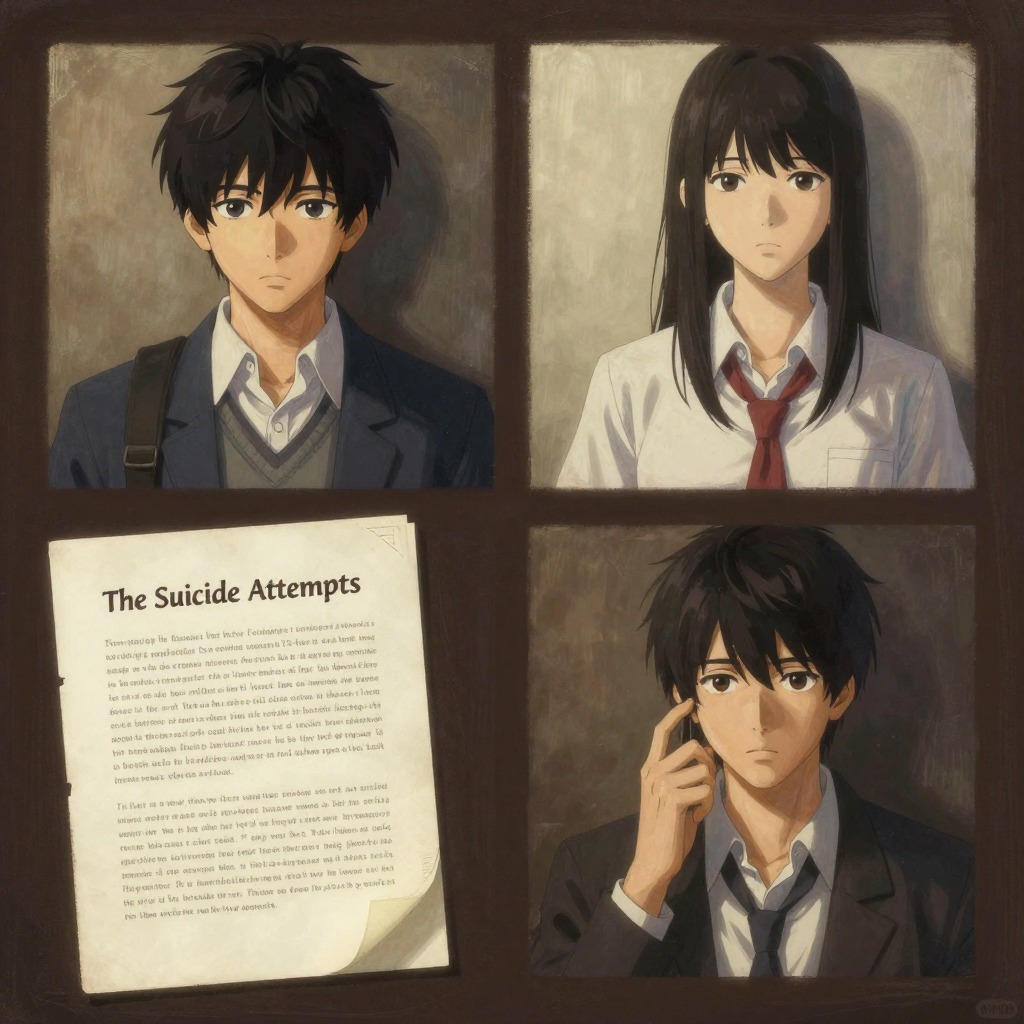
First Suicide Attempt (with Tsuneko)
The First Suicide Attempt (with Tsuneko) is the decisive rupture in Yozo's life, the moment when his accumulated dread of human beings, financial collapse, and emotional exhaustion crystallize into a concrete act of self-destruction. The attempt fails to kill him but succeeds in killing Tsuneko, the only woman he ever loved, and the aftermath—public scandal, family estrangement, a suspended criminal charge—permanently alters his trajectory, confirming his self-conception as a "social outcast" and accelerating his descent into alcoholism, morphine addiction, and institutionalization.
Background and Causes
By the autumn of his second year in college, Yozo had reached a state of complete exhaustion. He had stopped attending classes, neglected his painting, and was deeply entangled in the Marxist student movement, where he had been chosen leader of all action groups in central Tokyo. The movement's demands had become so frenetic that he could no longer perform them in the spirit of fun; he raced about in a raincoat carrying a knife bought for an armed uprising, though its blade was hardly strong enough to sharpen a pencil. His sickly body was not up to such frantic activity, and his only wish was to drink himself into a sound stupor, but he had no money. At the same time, three women were showing him special affection—the landlord's daughter at his lodging house, a female comrade from the teacher's training college, and the waitress Tsuneko—and his chronic lack of assurance drove him into desperate attempts to ingratiate himself with all of them. He felt bound to them by some ancient debt, and the pressure of these obligations, combined with his terror of human beings, made suicide seem the only escape.
The Night of the Attempt
Yozo had met Tsuneko at a café on the Ginza, where her simple words—"You needn't worry"—had calmed his agitation in a way no one else's ever had. She was a married woman two years older than himself, whose husband was in jail for swindling, and she too seemed weary beyond endurance of the task of being a human being. When Yozo lay next to her, her silent current of misery mingled with his own harsher gloom like a withered leaf settling to rest on the stones at the bottom of a pool, and he felt a night of liberation and happiness. But the morning after, he fled, spreading his usual smokescreen of farce, and did not see her for a month. When he finally returned to the café, drunk and accompanied by Masao Horiki, the sight of Horiki's contempt for Tsuneko—he refused even to kiss her, calling her a poverty-stricken woman—awakened in Yozo a feeling of comradeship and, for the first time in his life, a positive movement of love. He drank until he lost consciousness, and when he woke in her room, she proposed death. He consented easily, though an element of make-believe still lurked in his resolution. The next morning, wandering around Asakusa, they stopped at a lunch stand for milk. When Yozo opened his wallet to pay, he found only three copper coins. Tsuneko looked inside and said, "Is that all you have?" Her voice was innocent, but it cut him to the quick. It was a humiliation more strange than any he had tasted before, a humiliation he could not live with. That night they threw themselves into the sea at Kamakura. She untied her sash, saying she had borrowed it from a friend at the café, and left it folded neatly on a rock. Yozo removed his coat and put it in the same spot. They entered the water together.
Consequences and Aftermath
Tsuneko died. Yozo was saved. The incident was treated prominently in the press, no doubt because he was a college student and his father's name had news value. He was confined to a hospital on the coast, where doctors discovered that his left lung was affected—a diagnosis that proved fortunate when he was later taken to the police station charged with being an accomplice to suicide; he was treated as a sick man and quartered not with criminals but in a special custody room. The police chief, a young, dark-complexioned man with something about him suggesting a university education, told Yozo, "There's a handsome lad for you! It wasn't your fault, I can see. Your mother's to blame for having brought such a handsome boy into the world." The words made Yozo as wretched as if he had been born deformed. The district attorney, a man of about forty with an intelligent calm, saw through Yozo's feigned coughing of blood and asked with a quiet smile, "Was that real?" The gentle contempt was worse than any punishment Yozo could have imagined; he later wrote that he would have preferred ten years in prison. The charge was suspended, but Yozo was expelled from college, and all connections with his family were severed except for a small monthly allowance secretly sent by his brothers through Flatfish, the antique dealer who became his reluctant guardian. Yozo was left with nothing but the memory of Tsuneko—the only person he had ever loved—and the knowledge that he had failed even at dying.
Significance
The First Suicide Attempt is the event that transforms Yozo's abstract dread of human beings into a concrete, public shame. It confirms his self-diagnosis as someone "disqualified as a human being" and sets the pattern for all his subsequent self-destructive acts: the Dial overdose, the morphine addiction, and the final retreat into a living death in the countryside. The attempt also reveals the peculiar structure of Yozo's psychology: he is capable of consenting to death but incapable of carrying it through alone; he is drawn to women who are as broken as himself, yet he cannot sustain the connection; he performs sincerity so convincingly that even the authorities are briefly fooled, but the one person who sees through his performance—the district attorney—inflicts a wound that never heals. The event also marks the first appearance of the theme that will dominate the rest of the novel: the gap between Yozo's inner experience of suffering and the way others perceive him. The police chief sees a handsome boy; the old policeman sees a pathetic youth; the district attorney sees a manipulative actor; but Yozo himself sees only a coward who survived while the woman he loved died. The attempt is thus both a failed escape and a successful confirmation of his deepest belief: that he is fundamentally unfit for human life.